
Inhibition of the Dissolution of Calcium Carbonate Filler



RESULTS & DISCUSSIONS
Dissolution of GCC
 The
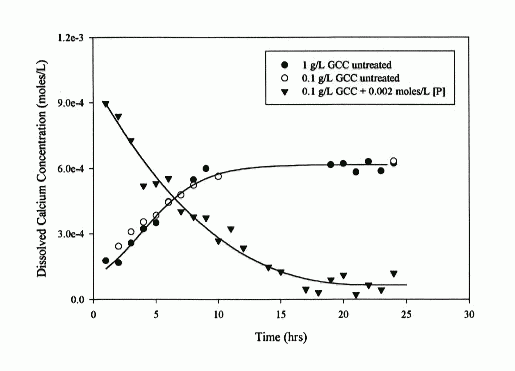
inhibitory effect by H3PO4 on the dissolution of GCC was first study. Figure
1 compares the dissolution profile of untreated GCC and GCC in the presence
of 0.2 g/g GCC H3PO4. The dissolution kinetics of untreated 0.1 wt. % and
1 wt. % GCC were found to be similar and both reached equilibrium after 10
hrs. The equilibrium dissolved Ca concentration (@ 24 hrs) of untreated 0.1
wt. % and 1 wt. % GCC were 6.33 ± 0.06E-4 moles/L and 6.2 ± 0.2E-4, respectively.
The
inhibitory effect by H3PO4 on the dissolution of GCC was first study. Figure
1 compares the dissolution profile of untreated GCC and GCC in the presence
of 0.2 g/g GCC H3PO4. The dissolution kinetics of untreated 0.1 wt. % and
1 wt. % GCC were found to be similar and both reached equilibrium after 10
hrs. The equilibrium dissolved Ca concentration (@ 24 hrs) of untreated 0.1
wt. % and 1 wt. % GCC were 6.33 ± 0.06E-4 moles/L and 6.2 ± 0.2E-4, respectively.
In the presence of 0.2g/gGCC H3PO4, the dissolution shown an opposite trend. Initially, the amount of GCC dissolved was very high due to the buffering action of H3PO4 which maintained the system under acidic condition. The Ca concentration then decreased gradually and reached an equilibrium concentration of 0.7 ± 0.1E-4 moles/L. Clearly, the dissolution of GCC was suppressed by the addition of H3PO4. The gradual decrease in Ca could be due to the precipitation of Ca-P containing compounds either as segregated crystals and/or at the GCC surfaces. Computer simulation indicated that the amount of phosphate in the system would exceed the solubility of calcium phosphate Ca3(PO4)2 and hydroxyapatite, Ca5(PO4)3OH.
 The
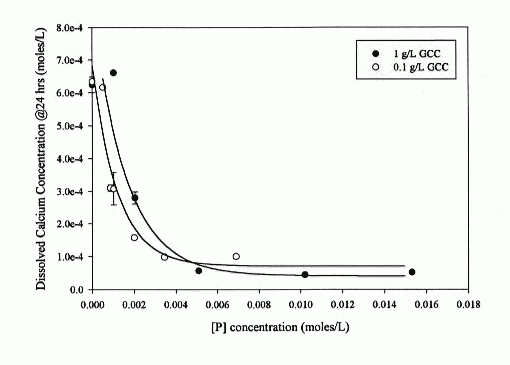
relationship between H3PO4 dosage and the inhibitory effect was examined by
comparing the dissolved Ca concentration after 24 hrs of stirring (Figure
2). For both concentration of GCC studied, the extent of inhibition increases
with increasing H3PO4 concentration and reaches a plateau. The optimum H3PO4
dosages for 0.1 and 1 wt. % GCC suspension were approx. 0.003 moles/L and
0.005 moles/L respectively. The existence of an optimum H3PO4 dosage was also
observed in our previous work (12).
The
relationship between H3PO4 dosage and the inhibitory effect was examined by
comparing the dissolved Ca concentration after 24 hrs of stirring (Figure
2). For both concentration of GCC studied, the extent of inhibition increases
with increasing H3PO4 concentration and reaches a plateau. The optimum H3PO4
dosages for 0.1 and 1 wt. % GCC suspension were approx. 0.003 moles/L and
0.005 moles/L respectively. The existence of an optimum H3PO4 dosage was also
observed in our previous work (12).
As will be discussed later, surface analysis of the treated GCC samples did not detect any crystals having different morphology from GCC which indicated that the Ca-P compounds were not presented as segregated crystals. The presence of GCC particles in the system can be served as crystallization seeds for the precipitation of the Ca-P compounds. As these Ca-P compounds form on the GCC surfaces, they can block the dissolution sites and inhibit the GCC dissolution. If the dissolution is eventually terminated, the dissolved Ca will continue to precipitate out with phosphorus. Hence, it is expected the equilibrium Ca concentration should be governed by the solubility of the least soluble Ca-P compounds. The equilibrium Ca concentration of a Ca5(PO4)3OH-H2O-CO2 system was calculated to be 1.19 x10⁻⁴ moles/L which was comparable to the experimental results.